Showing posts with label england. Show all posts

Thursday, May 19, 2011

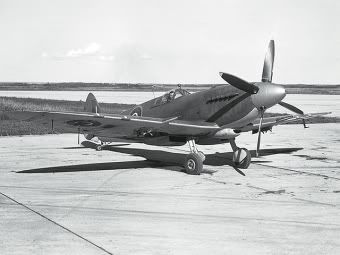
Aircraft 2: Supermarine (Sea Spitfire) 'Seafire'

Aircraft 2: Supermarine (Sea Spitfire) 'Seafire'

“To affirm that the aeroplane is going to 'revolutionize' navel warfare of the future is to be guilty of the wildest exaggeration.” - Scientific American, July 1910.

Nationality: English
Year of Production: 1938 (proposed), 1941 (produced)
Number built: 2669
Weight (empty): 3.9 tons
Wingspan: 11.2 metres
Length: 10.4 metres
Height: 3.9 metres
Speed: 578 kph (Merlin engine), 727 kph (Griffon engine)
Engine: Rolls Royce Merlin 55M V12, developing 1585 hp. Later, the Griffon 88 V12 would be used, developing 2350 hp.
Armament: 2x 20mm cannon, 4x 0.303 machine guns, later on, 4x 20mm cannon. (The Seafire F. Mk 47 had up to 8x rocket launchers, firing RP-3 air to ground rockets. They all could carry bombs, from 110 kg to 250 kg.)

Background: I daresay most people know about the beautiful little Spitfire, the aircraft that flew during the Battle of Britain, and during World War Two as a whole.

This story relates to the Seafire, trust me. Or not. Anyway, in 1931, the British Air Ministry was calling out for a new fighter plane capable of going at 404 kph. A man called Reginald Joseph Mitchell, of the Supermarine Aviation Works responded, with the Supermarine Type 224, which was rejected, as well as the later Supermarine Type 300, but eventually got accepted with the F7/30.

In 1936, the first prototype Spitfire flew, causing the RAF to squeal like schoolgirls and immediately order 310 of them, before the trials had been completed. Over 20,000 Spitfires, and the variants, would be built.

Unfortunately, while the RAF was enjoying their brand spanking new toy, the Fleet Air Arm were stuck with Blackburn Rocs and Gloster Sea Gladiators, of which, although they were decent aircraft... weren't quite as magnificent as the Spitfire.

The FAA got turned away from having their own Spitfires by Winston Churchill, but that's sort of understandable since that was during the Battle of Britain, and your own country's defense is more important then anything else, in my view.

However, in 1941, the Admiralty had a look at the Spitfire again, and 48 Spitfire Mark Vb aircraft were converted to have hooks on them, since a plane's not much good if it can't actually land. The new Seafires were used to get the Navy used to using their new toys, with modifications being constantly made, to make them more useful for general defense and attack purposes.

Why should I be afraid of it? And what was it for?

“The air fleet of an enemy will never get within striking distance of our coast as long as our aircraft carriers are able to carry the preponderance of air power to sea.” - Rear Admiral W. A. Mofflet, Chief of US Bureau of Aeronautics.

It's role was to hang around aircraft carriers, and to teach anything that isn't on it's side that the Royal Navy only wants pretty pictures and words taken when it damn well wants you to, and not whenever you want to.

The Seafire mainly operated in the Far East campaign against Japan, on the aircraft carrier HMS Indefatigable (R10), where they took on the kamikaze attacks, at one point taking out eight aircraft for the loss of only one of their own.

Post-World War Two, the Seafire was upgraded to the Mk47, and served in the Korean War, helping to blunt North Korean offenses in the skies and on the ground, with only two lost, one to friendly fire, and the other when the grappling hook failed to extend. Unfortunately, by the end of it, all but 3 of the Seafires in the 800 squadron were declared unservicable.

The Canadians and the French also used Seafires, the latter on the Arromanches (formerly HMS Colossus), which fought against the Viet Minh in the First Indochina War, before being withdrawn in 1949.

The Irish used the Seafire as well, but they didn't really seem to do anything much with them.

Ultimately, the Seafire, while in some ways a strong aircraft, was also a fragile thing, however, by all accounts it served magnificently. Then again, when you come from the same stock as the Supermarine Spitfire, how could you not?

Sources used:
Supermarine Seafire: Wikipedia
Fleet Air Arm Archive: Supermarine Seafire
Supermarine Seafire: Classic Warbirds
Supermarine Spitfire variants: specifications, performance and armament: Wikipedia

Wednesday, April 20, 2011

Ship 1: The Torpedo Ram class

Ship 1: The Torpedo Ram class.

“Ram him! RAM!” - Jeremy Clarkson

Nationality: Multiple nations had similar plans.
Year of Production: Proposed in early/mid 1870s, USS Intrepid (2) launched 1874, HMS Polyphemus (3) launched 1881.
Number built: Minimal.
Weight: 438 tons (Intrepid), 2640 tons (Polyphemus)
Length: 51 metres (Intrepid), 73 metres (Polyphemus)
Beam (width): 11 metres for both ships.
Draught (depth of water needed): 3.7 m (Intrepid), 6.25 m (Polyphemus)
Complement (crew): >1 (Intrepid), 80 (Polyphemus)
Speed: 11 knots (20kph) (Intrepid), 17.8 knots (33 kph) (Polyphemus)

Background: After the good Mr Robert Whitehead invented the torpedo in 1866, with help from Giovanni Luppis, who came up with the original, albeit different, concept, a few years before, Whitehead's son, John, and a worker called Annibale Ploech, the world's navies, beginning with the Austrian Imperial Navy, were quick to dream up many, many delicious ideas to use this new weapon.

Now, early torpedos, well, sucked if the target was actually moving, only going at a speed of 7 knots, or 13 kph, however, they were rapidly advancing in usefulness, with the gunboat Gemse being modified to fire them outside the factory where they were first being produced.

If the target wasn't moving, they'd be a safe weapon to use, fired from a great distance (600 metres), and with no shell flashes, or curses of shells landing on feet, etc, unless the ship carrying them got hit, in which case, it blew up. Although most ships that are hit in the ammo storage area usually do blow up.

Although the timeframe of this era of ship is not that long, you may, directly, or not, know of this class, as HMS Thunder Child, from War of the Worlds, by HG Wells.

Why should I be afraid of it? And what was it for?

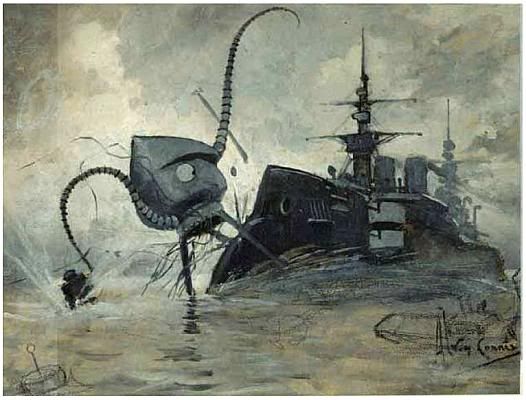
“It was the torpedo ram, Thunder Child, steaming headlong, coming to the rescue of the threatened shipping.” - War of the Worlds, HG Wells.

The torpedo ram class is absolutely goddamn insane. Early models, charge in, with the torpedo still attached to the ship, ram the other ship, which is probably full of very unhealthy stuff being fired at you, like shells, bullets, harsh propaganda and cruel insults, before either making it's way back, or blowing it's bow off.

Ships do not operate well with the front end of the boat missing. Ever.

Thankfully, as models advanced, the strategy became less suicidal, with torpedos being able to actually be fired, with the strategy being revised to 'charge in (through the hotel defenses, using the ram), blow target to smithereens from range, run like hell'.

Despite it being impractical, it had it's merits at the time, until... well, when they were finished being built.

The only torpedo ram used in war was the fictional Thunder Child, which, to be honest, in itself is awesome.

The three Martian tripod fighting machines fire gas at the ship, which does zilch. Then they deploy the heat rays, which mortally wound Thunder Child, but she rips apart one of the machines through ramming.

Thunder Child then turns to the second tripod, and starts firing the guns, but scores no real hits, as she lines up her ram and charges. The heat ray finds her again, and blows her up, with the resulting explosion taking out the second tripod.

After Thunder Child's sacrifice, three ironclads arrive, and, although the third tripod's fate isn't revealed, the fleeing civilians are able to escape.

Unfortunately, in real life, the torpedo ram class of ship was obsolete by the advent of quick firing guns on capital ships, to, say, protect them from some crazed idiot ramming his way through the harbour defenses, and firing his torpedos at a capital ship.

Both Polyphemus and Intrepid would be broken up for scrap, Polyphemus in 1903, and Intrepid in 1892.

A variety of other torpedo rams never got off the ground, which is a shame, in a sense. It's a ship built to ram much heavier stuff, and survive. And the ship, in itself, would provide a vast amount of kinetic energy.

And ultimately, the torpedo ram class remains, somewhere in the imagination of the public, through Thunder Child, taking out what was believed to be an invincible enemy.

Mr Whitehead's invention would remain in play up to, and beyond today, a valuable addition to the submarine, and to the world's navies and air forces in general.

His epitaph reads “His fame was known by all nations hereabouts.”

Sources used -
Wikipedia : Torpedo Ram
Wikipedia: Robert Whitehead
Wikipedia: HMS Polyphemus
Wikipedia: USS Intrepid
Wikipedia: HMS Thunder Child
Navy History - Intrepid
History of USS Intrepid CV-11
Global Security - Torpedo Ram

Thursday, April 7, 2011

Vehicle 1: The Churchill Crocodile

Vehicle 1: The Churchill Crocodile

“There are five ways of attacking with fire. The first is to burn soldiers in their camp; the second is to burn stores; the third is to burn baggage trains, the fourth is to arsenals and magazines; the fifth is to hurl dropping fire among the enemy.” - Sun Tzu's Art of War, Chapter 12.1, The Attack By Fire.

Nationality: English.
Year of Production: 1943
Number built: 800 conversion kits produced.
Weight: 38.5 tons
Length: 7.44 m
Width: 3.25 m
Height: 2.49 m
Crew: 5
Engine: 1x Bedford petrol engine, delivering 350 hp, for a speed of 24 kph.
(Specifications based on original vehicle, Churchill MkVII tank, without trailer.)

Background: In August 1942, Operation Jubilee (Operation Rutter, Battle of Dieppe, Dieppe Raid) was launched, a Allied attack on the French port town of Dieppe.

The primary aim was to hold Dieppe, to gather intelligence from prisoners, and to see the German response, as well as blow the thing to bits as they were leaving.

Unfortunately, the raid went pretty badly, to put it mildly, with over 3500 men being wounded, killed or captured, with the vast majority of that number being Canadian. German casualties were about 500 wounded or killed.

Among some of the tanks bought ashore to assist with the raid were modified Churchills, named Churchill Okes, having Ronson flamethrowers equipped. Unfortunately, they got blown to bits in the first wave.

As a result of the failed raid on Dieppe, Allied command realized they needed a range of modified armoured vehicles, given that the 58 Churchills bought along on the raid struggled with the defenses, which is a bad thing if, say, a player in the Allied forces, like France, wanted their country liberated pretty damn quickly, through, say, an invasion. And if, Europe was known as Fortress Europe at the time.

To achieve that aim, in 1943, one of the men called in to create these vehicles was Major-General Percy Hobart, and his division, the 79th Armoured. The division was renamed the 79th (Experimental) Armoured Division Royal Engineers”, and they set to work.

Even though some of the concepts had been used before, some of their other vehicles were quite amazing, if say, you had a rifle and were trying to take one on, let's see how you'd do against a couple of these, the whole list being very much longer...

The Crab flail tank (modified Sherman), aimed at making minefields fire off early, rather then, say, blowing men or normal tanks back to England, of which one assumes that the men and tanks liked not being blown to bits. It could also be used to satisfy Earth's masochistic tendencies, one assumes. And to make bad puns like 'Epic Flail.'

The Churchill Armoured Vehicle Royal Engineers, which had a mortar on it. By mortar, I mean a 290 mm mortar, which considering the main gun was a 75 mm cannon, it would be a bad idea to be bonked on the head by it's 18 kg high explosive charge. And could carry bridge sections, fascines (big bundles of wood, you put them in trenches and drive over.) and other sapper related equipment.

Why should I be afraid of it? And what was it for?

“Set Europe ablaze.” - Winston Churchill, attributed, creating the Ministry of Ungentlemanly Warfare.

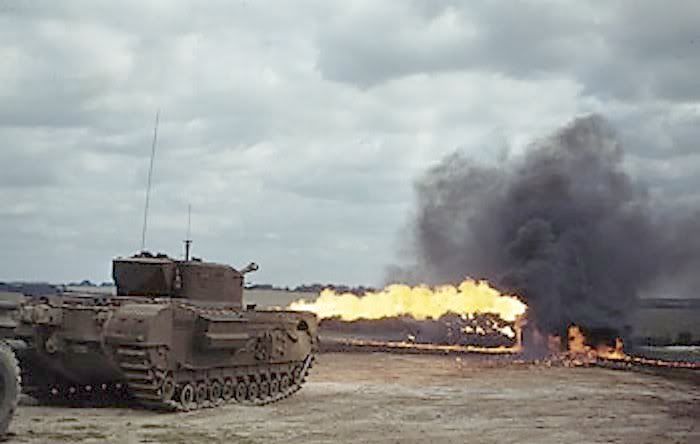
The Churchill Crocodile. Now, the thing about a normal tank is that it has a main cannon, for getting rid of other vehicles, like, say, another tank, and a machine gun or a few other smaller weapons, for in case infantry want to add some holes to the tank, drag you out and hurt you. Which would be bad if you're not into getting hurt.

The thing about a flame tank is that it has a flamethrower on it. Now, it's obvious that being set on fire is a bad thing. There's the saying, 'Give a man fire, keep him warm for a day, set a man on fire, keep him warm for the rest of his life.'

Now, if you're a man in the open, with a flamethrower, then you're going to take a lot of shots fairly quickly, since fire's a more terrifying weapon then a bullet is. But if you're in a heavily armoured tank, then the bullets'll be fairly ineffective.

But what if you did the stereotypical thing, and replaced the main cannon with a flamethrower?

Well, if you come across a German tank, since Italy had declared war on it's former ally and was no longer the enemy, they'd probably batten the hatches, laugh as you heat their coffee and make some fire-related quip, like “We'll see how their firepower matches against our firepower!” and blow the tank away.

And, what if you did the rational thing, replacing the machine gun, an anti-infantry weapon, with a flamethrower, which is also an anti-infantry weapon?

You end up with the Crocodile. Towing it's 6 and a half ton fuel trailer behind it, holding 1800 litres of fuel, it fires bursts of liquid flame between 110 to 135 metres away. Or fires unlit lighter fluid, lets it slosh around a bit, and then sets fire to it.

Oh, and the fire burned on water.

Despite it's short range, it forced troops to retreat and bunkers to surrender, since being burnt alive in a tiny little concrete box is a bad thing to happen.

The trailer could be dropped from inside the tank if it ran out, or was shot up, making the Crocodile a burning, flaming death tank that could take out it's peers, while using man's primal fear, fire, against him.

It stormed across the beaches of Normandy in June, 1944, with it's friends, the other Hobart's Funnies, assisting the Allied invasion of Normandy, getting the liberation of France on.

And one can only assume that France really enjoyed being liberated from the heel of the jackboot.

As for the good Major-General, his 79th being described as the decisive factor on D-Day? He went back to retirement in 1946, after being awarded the Legion of Merit, which went in well with his Knight Commander of the Order of the British Empire, his Distinguished Service Order, his Military Cross, and his Companion of the Order of the Bath. He died in 1957, his vehicles, in my opinion, a tribute to the ingenuity of the British engineer.

Sources used:
Timelines of World War II, 1942, 1943, 1944: Wikipedia

Churchill Crocodile: Wikipedia
Dieppe Raid: Wikipedia
Hobart's Funnies: Wikipedia
Percy Hobart: Wikipedia
Churchill Tank: Wikipedia
Sun Tzu's Art of War
Personal knowledge, or what little there is of it.